CASE STUDY / PACKAGE QUALITY
Separating dent events from foreign material inspection.
In an anonymized canned-tuna application, GreyscaleAI used application-specific AI trained on real production X-ray images to classify sidewall deformation as a dedicated dent signal while the inspection workflow continued to treat foreign material as a separate event type.
AT A GLANCE
THE CHALLENGE
A package-quality event was hidden inside a general reject workflow.
The production team needed to identify sidewall dents at a high reported inspection rate without treating every can variation as a defect and without blending package-quality events into the foreign material reject category. A generic reject count could remove a can from the line, but it did not tell QA whether the event was a dent, a product or presentation variation, or a foreign material concern.
The reason code mattered
A dent event needed its own classification so teams could separate package quality from foreign material activity.
The image distinction was subtle
Can edges, fill distribution, orientation, and image artifacts could create patterns that resembled sidewall deformation.
The line moved at high throughput
The classification had to remain useful at the inspection rate and production conditions represented in the application.
WHY IT WAS HARD
A rigid template could not represent every normal can image.
Can geometry, seam position, fill distribution, product density, orientation, motion, and image contrast can all change the X-ray pattern. A fixed template may catch only obvious deformation or may respond to normal variation as though it were a dent. The model needed to learn confirmed dent examples, normal canned-product images, difficult lookalikes, and the distinction between a package-quality event and a foreign material event.
The application needed two separate answers from the same inspection workflow: is this a dent-related package-quality event, or is it a foreign material event?
THE GREYSCALEAI APPROACH
Train and back-check a dedicated dent classification with real production images.
GreyscaleAI used representative canned-product X-ray images to define dent-related sidewall deformation separately from normal can appearance, difficult image variation, and foreign material classifications. The resulting model and reason-code workflow were evaluated against the historical image set and the production conditions represented in the application.
Capture representative cans
Include confirmed dent events, normal cans, difficult lookalikes, and relevant production variation.
Label separate event types
Keep dent-related package quality, normal product variation, and foreign material events as distinct classes.
Train and back-check
Evaluate model decisions against known examples and the historical image set represented in the application.
Validate the production workflow
Confirm the image distinction, reason code, inspection rate, review process, and acceptance criteria under the conditions in scope.
WHAT THE SYSTEM ANALYZED
The decision came from the can image and the event distinction.
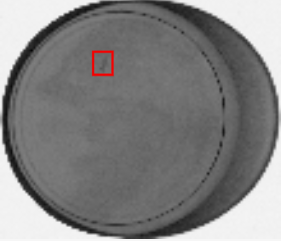
The model evaluated canned-product images for sidewall deformation, comparing confirmed dent events with normal can geometry, fill variability, orientation changes, and image artifacts. The classification remained separate from the foreign material event type so the resulting signal could support a different QA and operations workflow.
 Dent-related event
 Comparison image
INSIGHTS VISIBILITY
A dent event became a separately reviewable quality record.
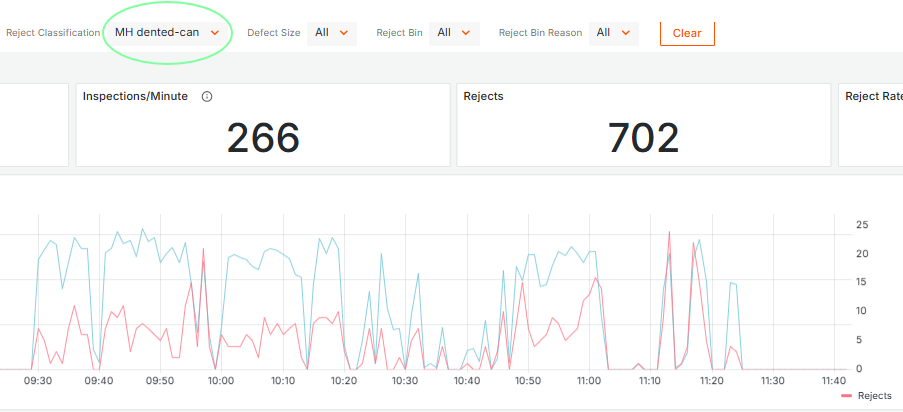
In GreyscaleAI Insights, authorized users could review dent activity as its own classification instead of finding it inside a blended reject total. The dedicated event type made it possible to review available image evidence and compare dent patterns across products, lines, shifts, and time windows when that production context was connected.
REPORTED OUTCOME
A package-quality condition became a dedicated inspection signal.
The application separated dent events from foreign material events. Quality supervisors could monitor Dented Cans as a dedicated classification in GreyscaleAI Insights and review the signal across shifts, products, lines, and time windows when the required production context was available. The proof point is the separation and visibility of the quality signal, not a universal claim about every can defect.
Dent events were not blended into the foreign material event type
Dented Cans appeared as a dedicated quality classification
The signal could be compared across available production dimensions
Performance is application-specific. Can geometry, material, seam position, fill, product density, orientation, dent location and severity, image contrast, inspection rate, event definitions, and acceptance criteria must be validated for each application.
WHERE THIS PROOF APPLIES
Use this case study when a package condition needs its own reason code and review path.
This story is most relevant when a visible X-ray pattern associated with container deformation needs to be classified separately from foreign material or a general reject. It supports a discussion about application-specific AI, dedicated event definitions, image-backed QA review, and trend visibility. It does not establish complete can-integrity inspection or guaranteed dent classification for every canned product.
QA
Review the X-ray evidence and classification behind a dent-related event before disposition.
Packaging operations
See whether dent activity is isolated or recurring across products, shifts, lines, or time windows.
Quality leadership
Use a common event definition to compare package-quality patterns across authorized operations.
NEXT STEP
Bring the can, dent definition, line speed, and reject workflow.
Share the product and fill, can dimensions and material, examples of acceptable and unacceptable deformation, normal and maximum inspection rate, current reject reason codes, and QA review process. GreyscaleAI can help define the image set, event classification, validation plan, and inspection-system fit for the application.